Machine Model: DER_A
 AutoCorrection Properties
Following checks and corrections are applied during Validation and AutoCorrection.
- If 0.0 < Trv < 0.5*Mult*TimeStep then Trv = 0, ElseIf 0.5*Mult*TimeStep < Trv < Mult*TimeStep then Trv = Mult*TimeStep
- If 0.0 < Tp < 0.5*Mult*TimeStep then Tp = 0, ElseIf 0.5*Mult*TimeStep < Tp < Mult*TimeStep then Tp = Mult*TimeStep
- If 0.0 < Tiq < 0.5*Mult*TimeStep then Tiq = 0, ElseIf 0.5*Mult*TimeStep < Tiq < Mult*TimeStep then Tiq = Mult*TimeStep
- If 0.0 < Tpord < 0.5*Mult*TimeStep then Tpord = 0, ElseIf 0.5*Mult*TimeStep < Tpord < Mult*TimeStep then Tpord = Mult*TimeStep
- Only the absolute value of the deadband values are used (dbd1, dbd2, fdbd1, and fdbd2)
- Only the absolute value of the droop values Ddn and Dup will be used
- If Vl0 < Vl1 then the parameters Vl0 and Vl1 will be treated as though they are 0.0 (we'll ignore the low voltage tripping)
- If Vh1 < Vh0 then the parameters Vh0 and Vh1 will be treated as though they are infinite (we'll ignore the high voltage tripping)
- If Vrfrac < 0 it will be treated as 0. If Vrfac > 1.0 it will be treated as 1.0
- If Tg < 4*TimeStep then Tg will use 4*TimeStep, and if Tg > 0.2 then Tg = 0.2
Mult represents the user-specified value Minimum time constant size as multiple of time step option on the Validation page of the Transient Stability Dialog
TimeStep represents the integration time step being used as described on TimeStep
Model Equations and/or Block Diagrams
Parameters:
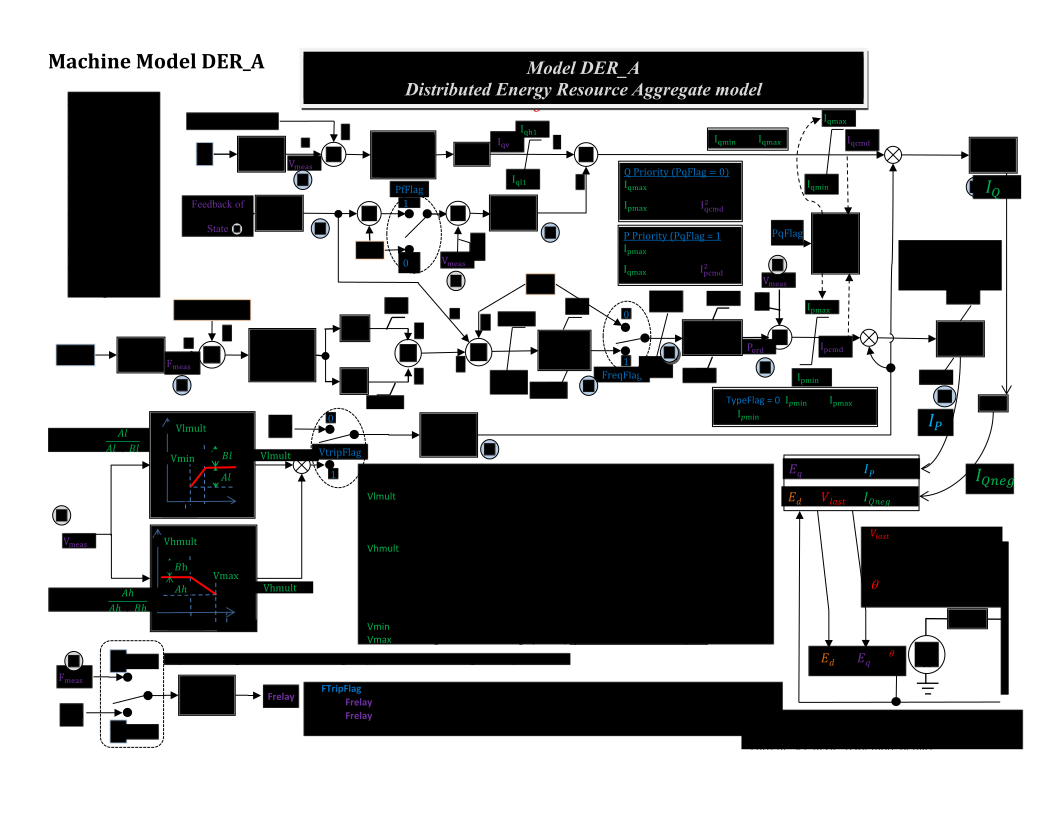
| PfFlag | PfFlag: 0 means for constant Q control; 1 means constant power factor control (any number which is not 0 is treated as 1) |
| FreqFlag | FreqFlag: 0 means frequency control disabled; 1 means frequency control enabled (any number which is not 0 is treated as 1) |
| PQFlag | PQFlag: 0 means Q priority; 1 means P priority for current limit (any number which is not 0 is treated as 1) |
| TypeFlag | TypeFlag: 0 means the unit is a storage device and Ipmin = - Ipmax; 1 means the unit is a generator Ipmin = 0 (any number which is not 0 is treated as 1) |
| VtripFlag | VtripFlag: 0 means disable the voltage trip logic; 1 means enable the voltage trip logic (any number which is not 0 is treated as 1) |
| FtripFlag | FtripFlag: 0 means disable the frequency trip logic; 1 means enable the frequency trip logic (any number which is not 0 is treated as 1) |
| Trv | Trv: transducer time constant (seconds) for voltage measurement (can be zero) |
| Trf | Trf: transducer time constant (seconds) for frequency measurement (> 0) |
| dbd1 | dbd1: lower voltage deadband <= 0 (pu) |
| dbd2 | dbd2: upper voltage deadband >= 0 (pu) |
| Kqv | Kqv: proportional voltage control gain (pu/pu) |
| Vref0 | Vref0: voltage reference set-point (pu) |
| Tp | Tp: transducer time constant (seconds) |
| Tiq | Tiq: Q control time constant (seconds) |
| Ddn | Ddn: frequency control droop gain >= 0 (down-side) |
| Dup | Dup: frequency control droop gain >= 0 (up-side) |
| fdbd1 | fdbd1: lower frequency control deadband <= 0 (pu) |
| fdbd2 | fdbd2: upper frequency control deadband >= 0 (pu) |
| femax | femax: frequency control maximum error (pu) >= 0 |
| femin | femin: frequency control minimum error (pu) <= 0 |
| Pmax | Pmax: Maximum power (pu) |
| Pmin | Pmin: Minimum power (pu) |
| dPmax | dPmax: Power ramp rate up >= 0 (pu/s) |
| dPmin | dPmin: Power ramp rate down <= 0 (pu/s) |
| Tpord | Tpord: Power order time constant (seconds) |
| Kpg | Kpg: active power control proportional gain |
| Kig | Kig: active power control integral gain |
| Imax | Imax: Maximum converter current (pu) |
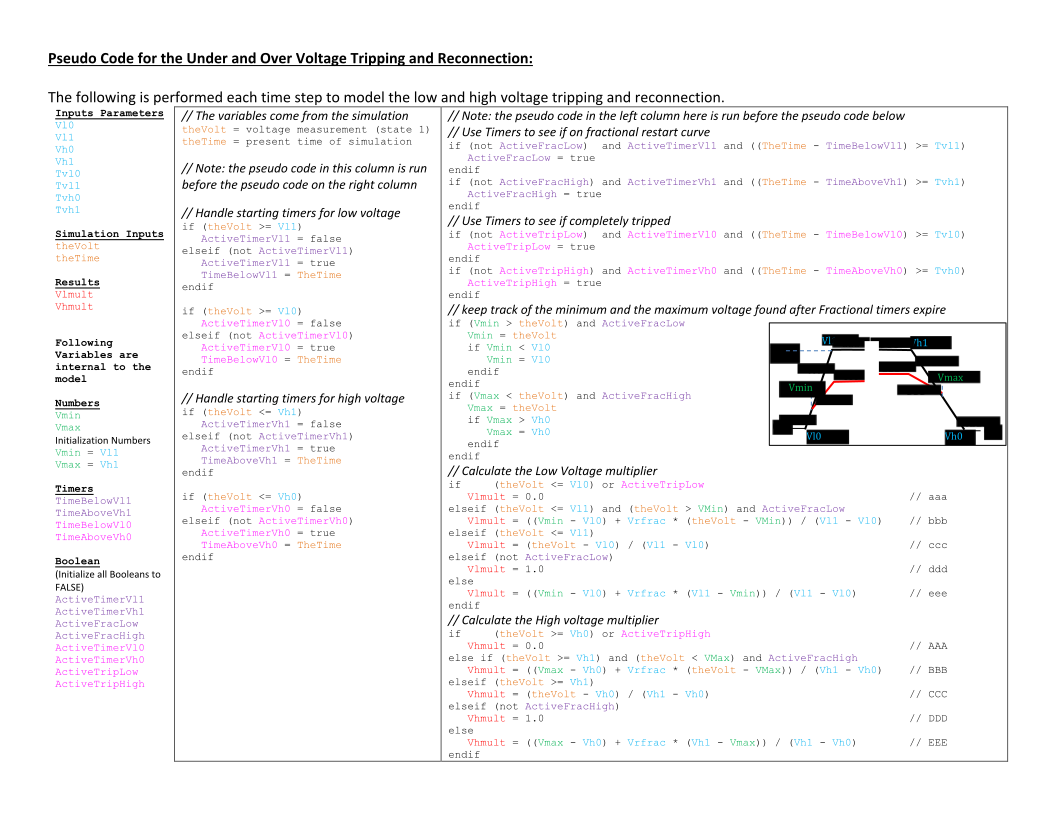
| Vl0 | Vl0: voltage break-point for low voltage cut-out of the inverter (Multiplier = 0.0 at this voltage) |
| Vl1 | Vl1: voltage break-point for low voltage cut-out of the inverter (Multiplier = 1.0 at this voltage) |
| Vh0 | Vh0: voltage break-point for high voltage cut-out of the inverter (Multiplier = 0.0 at this voltage) |
| Vh1 | Vh1: voltage break-point for high voltage cut-out of the inverter (Multiplier = 1.0 at this voltage) |
| Tvl0 | Tvl0: voltage break-point for low voltage cut-out timer (If voltage stays below vl0 for more than tvl0 seconds, then the multiplier will remain zero for the simulation) |
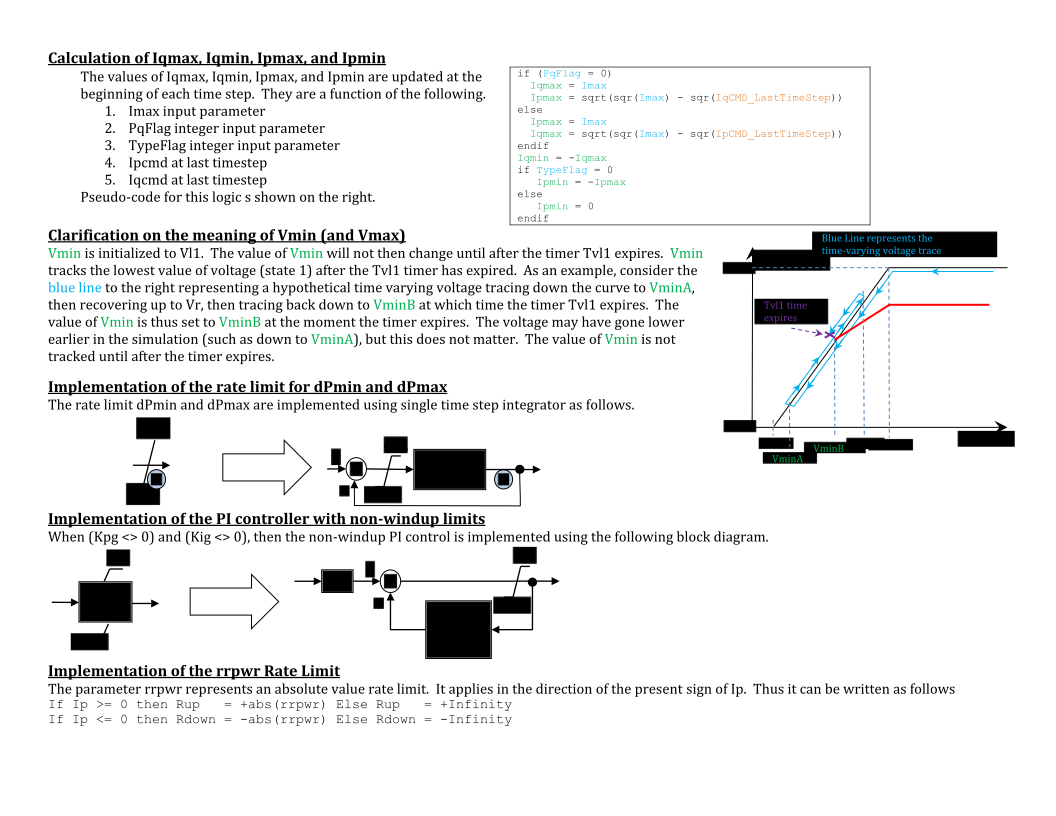
| Tvl1 | Tvl1: voltage break-point for low voltage cut-out timer (If voltage stays below vl1 for more than tvl1 seconds, then the multiplier will track a depressed curve according to Vrfrac and an internally tracked value of the minimum voltage experienced during the simulation) |
| Tvh0 | Tvh0: voltage break-point for high voltage cut-out timer (If voltage stays above vl0 for more than tvl0 seconds, then the multiplier will remain zero for the simulation) |
| Tvh1 | Tvh1: voltage break-point for high voltage cut-out timer (If voltage stays above vl1 for more than tvl1 seconds, then the multiplier will track a depressed curve according to Vrfrac and an internally tracked value of the maximum voltage experienced during the simulation) |
| Vrfrac | Vrfrac: fraction of device that recovers after voltage comes back to within vl1 < V < vh1 (Note that the timers Tvl1 and Tvh1 also impact when this fraction is used) |
| Tv | Tv: time constant on the output of the voltage cut-out |
| fl | fl: frequency break-point for low frequency cut-out of the inverter (Hertz) |
| fh | fh: frequency break-point for high frequency cut-out of the inverter (Hertz) |
| Tfl | Tfl: frequency break-point for low frequency cut-out timer (seconds) (highly recommend that Tfl > Trf) |
| Tfh | Tfh: frequency break-point for high frequency cut-out timer (seconds) (highly recommend that Tfh > Trf) |
| Vpr | Vpr: voltage below which frequency tripping is disabled (pu) |
| Tg | Tg: Current control time constant |
| rrpwr | rrpwr: Power rise ramp rate following a fault >= 0 (pu/s) |
| Xe | Xe: Generator effective reactive (pu) > 0 |
| Iqh1 | Iqh1: Maximum limit of reactive current injection, p.u. |
| Iql1 | Iql1: Minimum limit of reactive current injection, p.u. |