GetParamsRectTyped Function
The GetParamsRectTyped function is used to request the values of specified fields of a specified type for a set of objects in the case. The fields that are returned must all be convertible to the specified type. This function is similar to the GetParametersMultipleElementRect function but has the advantage of specifying the data type of the returned fields rather than returning all values as strings.
Function Prototype
GetParamsRectTyped(ObjectType, ParamList, Filter, ValueType)
Parameter Definitions
ObjectType : String The type of object for which parameters are being retrieved
ParamList : Variant A variant array storing strings. This array stores a list of PowerWorldâ object field variables, as defined in the section on PowerWorld Object Variables, for the values to retrieve from Simulator.
Filter : String The name of an advanced filter, a device filter, or a single-condition filter. If no filter is desired, simply pass an empty string. An error will be returned if a named filter cannot be found, device cannot be found for a device filter, or a single-condition filter is in the wrong format.
ValueType : VARENUM type Enumerated type representing supported variant type. The supported types are VT_I2, VT_I4, VT_R4, VT_R8, VT_BSTR, and VT_VARIANT. The values for all fields must be convertible to this type. For example it is invalid to retrieve a branch status field as an integer or float, but it is valid to retrieve a numerical field into a string or variant array.
Output
When Difference Case Tools and DiffCaseMode = Change, then using the various get parameters calls will only return objects that have input parameters specified that have at least one non-key field that has changed.
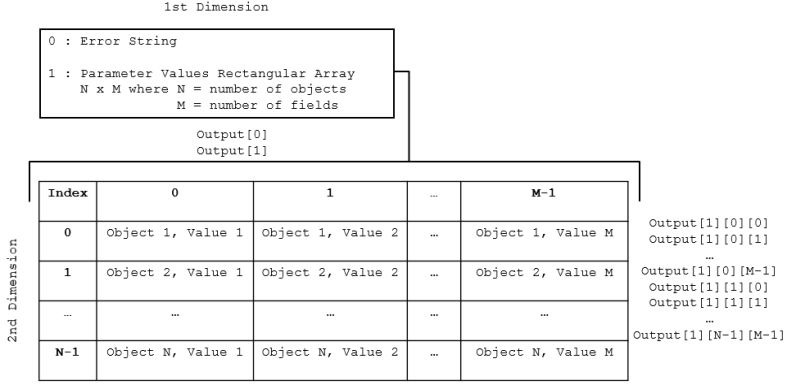
The output is a variant array:
Output(0) — error string
Output(1) — Two-dimensional array with each row representing an object and the corresponding columns representing each field in ParamList for that object returned as the specified ValueType
Output Structure
The Output structure is shown in the following figure: